
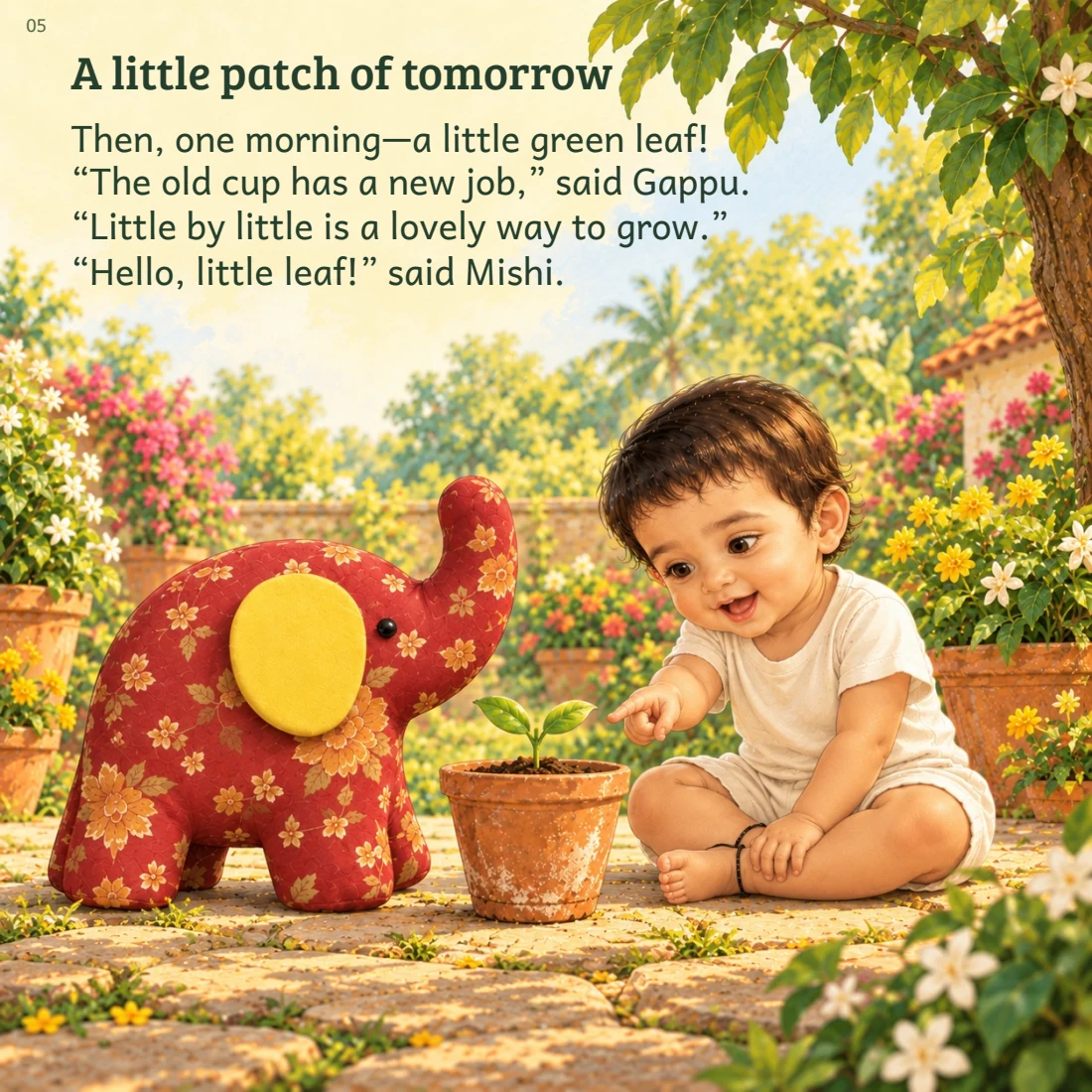
In The Little Patch of Tomorrow, an old cup becomes a home for a seed. Mishi and Gappu give it a small sip of water and come back to look. For a while, there is only soil.
“We can’t hurry a seed,” says Gappu. “But we can keep it company.”
That is the kind of idea we like to leave inside a story: something a child and grown-up can return to together, without a test or a right answer waiting at the end.
Share the waiting
Waiting can feel long when you are little. A pretend garden gives you a way to keep it company, just as Gappu does. Cup your hands around an imaginary seed. Give it a tiny pretend drink. Find a place for it in the sunshine of your story.
You might ask, “What shall we do while our seed rests?” Perhaps the toys go for a walk. Perhaps they make up a song. The pause becomes part of the adventure rather than a gap you have to fill with instructions.
Let the story leave space for feelings
Your child might want the leaf to appear straight away. You can acknowledge that wish: “You really want to see it grow.” There is no need to turn the moment into a lesson about being good at waiting.
In pretend play, the seed may grow into a giant tree in a second. That is welcome too. Another day, you can return to Gappu’s slower version and see what your child makes of it.
Give trying again a place in the game
A toy picnic falls over. A pretend plant has not grown yet. A character takes a wrong turn. These small story moments offer an opening to wonder together: “What could we try now?”
You don’t have to supply the solution immediately. Your child may have an unexpected answer, or they may ask you to help. Both can be part of playing together.
Notice care, as well as the result
In Gappu’s garden, the leaf is a lovely surprise. But the small acts before it matter to the story too: finding a new use for the cup, giving a little water, and coming back to look.
You can notice those actions as you read. “They remembered their seed today.” “Mishi came back to say hello.” It keeps the conversation close to what the characters actually do.
Read Gappu and Mishi’s garden book at your own pace. Pause for a picture, return to a favourite page, or let your child tell you a completely different ending.